
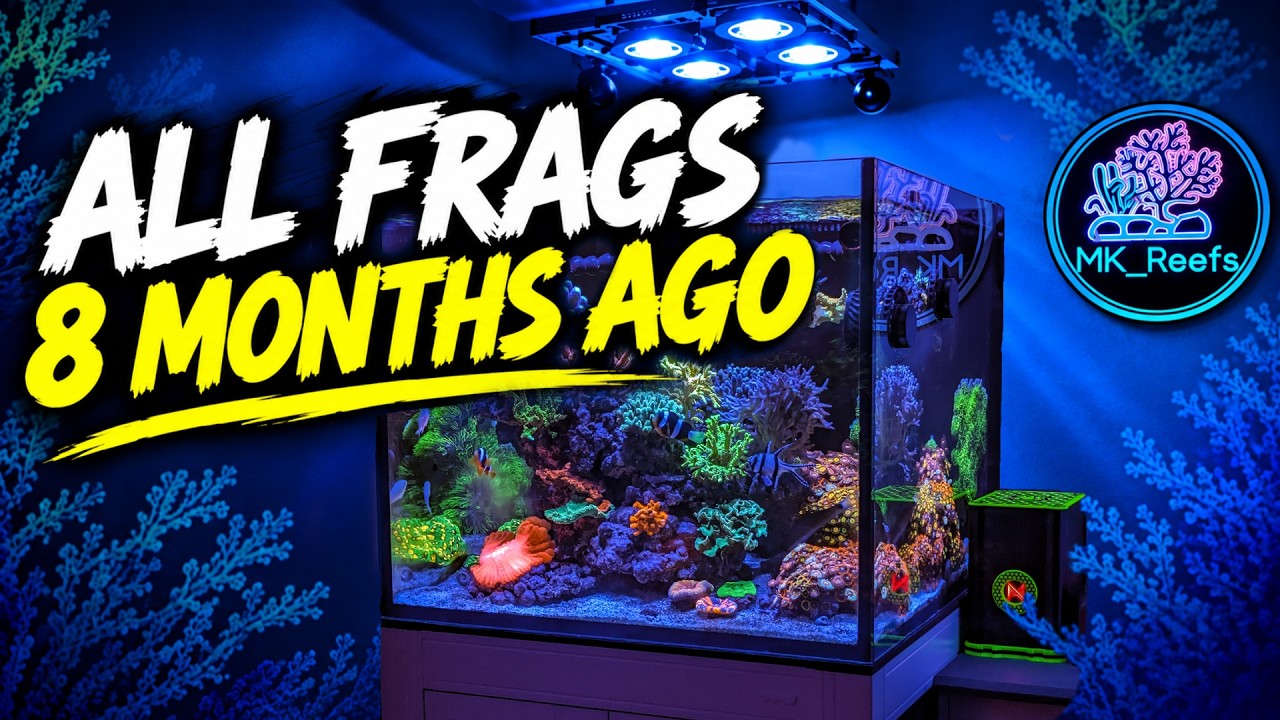
Mike (@mk_reefs) first came on the show back in episode four with his entryway ten gallon. This time he is back with the tank that replaced his packed 20 gallon: a 50 gallon cube that has been running about eight months and, in his words, is probably the hardest tank he has ever started up.
A $500 day trip upgrade
The tank came from a day trip to Myrtle Beach, South Carolina with his wife. He paid $500 for an older Innovative Marine style cube with a built-in sump, spray painted the stand white, and cleaned it up. He had been planning to buy a Waterbox 35 but wanted more room, and at roughly 24 by 24 by 22.5 inches the cube turned out to be the right size for the space.
The upgrade was overdue. His old 20 gallon was so jammed with coral that he could no longer keep up with alkalinity, even with lye, kalkwasser and soda ash all in the mix. Corals were dying and STNing, so he cut everything up and moved it into his frag system to give it the best chance of survival.
A rough start, and a lot of growth
The new tank did not start easy. It went through cyano, and Mike admits he may have added SPS a little too early, which caused some die off. You can still see algae on a few of the old spots, but he is leaving them alone and letting the colonies repair themselves.
Everything else was new: dry rock from AquaForest, fresh sand, and AquaForest reef cement to build the scape. Every coral in the display started as a frag from his own grow out. "Eight months ago, every coral in Mike's 50 gallon cube was a frag."
The aquascape
The scape is about 25 to 30 pounds of rock, glued into two separate structures with a small swim through between them. A top arch holds the high light corals, including a Bill Murray acro, a creamsicle and a Miyagi tort, while the lower light SPS sit toward the middle and bottom. A purple stylophora and a neon green elkhorn fill in the sides. The elkhorn came from a reefer friend, Alyssa, who got it from Lacey, who brought it back from a show. Lacey runs the Carolina Reefing Community (CRC), a group Mike joins for the monthly Zoom meetings when he can get the kids to bed in time.
Down in the shade sits a Raja Rampage chalice, and Mike has found the less light he gives it, the faster it grows. The Raja Rampage and a Space Invader are the only two chalices he keeps, because he wants to hold onto both. Nearby are an orange Montipora setosa that STNed early on and is slowly encrusting back over the spot, a Pavona potato chip from Premier Reefs that started as a single chip, and three Scolymia, including a war paint and an A grade bleeding apple. A few of the higher end acros, like a golden rod and a Green Goblin, came from a local SPS grower, Rebel Reef.
On the left, a zoa garden covers about 15 pounds of rock, with white zombies, hornets, firing ice, scrambled eggs and rastas. The whole bottom of the old 20 gallon was covered in zoas, so Mike scraped them off with a drywall knife, dropped them in a basket and glued them on one at a time. Above the swim through hangs a pink spurge nest that looks blue under blue light and pink under white.
Light, fish and the overflow
The tank runs an Illumagic X4 on blues for most of the day, with newer style pixel light bars added at peak photoperiod for extra white light. Mike says it is overdone, but he overdoes a lot of his tanks. The fish list includes a blenny, a clownfish, a cardinal, a sand sifting goby and a wrasse, plus a couple of Chromis (he started with four, and two picked off the others). Most came from local stores, with a few from Reef Beauties.
The overflow has three pipes: an emergency in the middle, a primary and a secondary feeding the return section. Mike 3D printed his own overflow cover, and the back is where he keeps his Apex probes. Under the stand is a roughly 15 to 20 gallon sump with a skimmer, carbon reactor, UV sterilizer, auto top off, a wavemaker, and a four bay Auto Aqua doser for extra additives. He added manifolds so he can fill a cup with frozen food right at the stand.
Maintenance and dosing
Mike ran RODI lines from under his house up to his lab and set up automatic water changes, so the tank gets one gallon a day, or seven a week, of Waterbox Reef salt. If he vacuums the sand he does a five gallon change by hand, but otherwise the tank is mostly hands off.
His dosing has changed a lot. At first he autopiloted the tank with AquaForest Components 1, 2 and 3, then spent a couple of months on All For Reef before deciding it was not sustaining the tank the way he wanted. Now he doses a two part for alkalinity and calcium, adds magnesium by hand (Red Sea or AquaForest, whichever he finds strongest), and gives a small daily dose of AcroPower for aminos. He went from dosing thirty something milliliters a day of All For Reef to about fifteen milliliters of two part, and he thinks the daily water change is part of why. A Neptune Trident does his testing, with a second alkalinity monitor running next to it so he can watch both.
The main lesson from the 20 gallon is simple: watch alkalinity. More water volume has made the whole process a lot less of a headache.
The frag lab
The tour moves into Mike's lab, home to a big frag tank, a couple of smaller tanks and plenty of experiments. The frag tank has its own sump, which he calls the "Jake Adams sump" because he designed it after Jake's: a 40 gallon breeder with two four inch socks, a return pump and a skimmer. A bed of calcium reactor media gives the mushrooms and softies something to attach to, and it makes it easy to throw on a frag plug.
It is lit with twelve pixel lights plus what Mike calls his "Fessils," knockoff Kessils that run three hours a day for extra white light. He measures about 250 PAR on the frag racks from roughly 220 watts of light, which is less than half of what four 100 watt fixtures would use. Flow comes from two Hygger wave makers.
Next to it is a ten gallon Fiji cube full of green star polyps. Because it is plumbed into the same system, it works as a canary tank: if the GSP closes up, Mike knows something is wrong. He grows zoas, including Yodas, Exospheres and Jedi Mind Tricks, plus torches, hammers, a mushroom corner with King Kongs and red discosoma, a few plate corals and a lot of SPS. Mike keeps up with it by fragging his frags, and he sells and trades to other hobbyists since he does not have a great local fish store. The nearest good one is over an hour away.
Mike keeps fish mostly as workers: a sailfin tang, two Scopas and a fox face that keeps the egg crate clean of algae, plus a few damsels. "It's all coral for me," he says. "I like growing the coral and the math behind it."
Where to find Mike
You can follow Mike as @mk_reefs on Instagram and TikTok. He is also active in Facebook groups on his personal profile, and he says to reach out with any questions and he will do his best to help.