
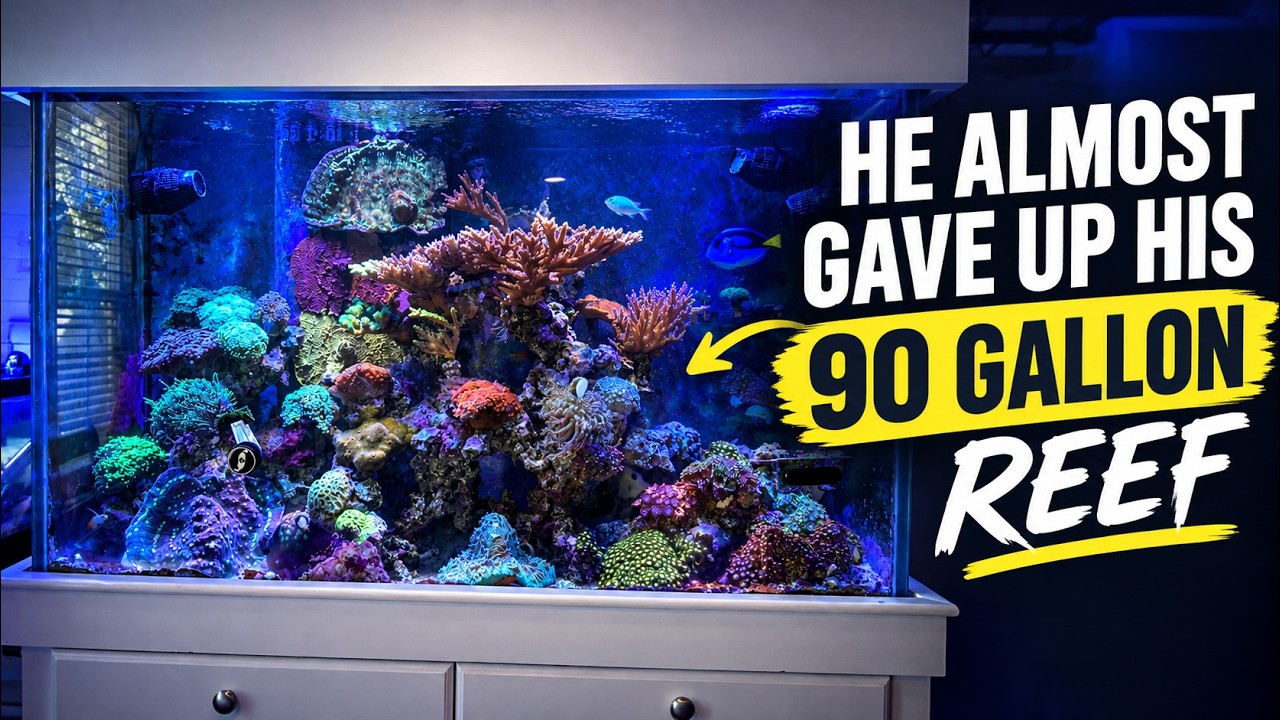
Adrian didn't start with a 90-gallon showpiece in his dining room. He started with a 20-gallon long tucked into a corner of his old house, running a hang-on-back filter and a single AI Prime light. He calls it "the jankiest setup" he ever had. That was about six years ago, right after COVID, when a video popped up on YouTube and he decided he wanted to try it.
Coral is what hooked him, not fish. He keeps fish, but they've never been the focus. From that first 20-long he moved up to a Red Sea reef-ready cube (about 25 gallons, all-in-one with a built-in sump), and it didn't take long before the acros he'd started collecting outgrew it. "They started growing pretty fast," he says, "and I was like, well, time to upgrade."
The upgrade found him the way most of his gear does: on Facebook Marketplace. He mentioned to his wife that he wanted to go bigger. A tank popped up the next day, and he was driving an hour to pick it up before he'd really thought it through. It came with the tank, a sump, and a stand, all of it painted black. Adrian sanded it down, repainted it white, and spent a couple of months building the rockwork by hand instead of just piling rock in, gluing pieces together into arches. Because the tank runs unusually tall, he built the structure up toward the surface on purpose, so the light would reach the top instead of leaving empty space.
Almost everything in the system came the same way, secondhand, picked up through patience rather than a shopping list. The powerheads across the top are an older set he only knows as "Corelia," run off what he describes as an old computer-looking controller box. The return pump for the main tank is a Current Loop that came with the original setup. Even the sump was a replacement. The one that shipped with the tank turned out to be an unbranded acrylic box that started leaking after a few months, so he tracked down a ProClear sump, another Marketplace find that already had the compartments he needed. The protein skimmer, a Bubble Magus Curve 7, came with the original build and has worked well since.
Almost done with it
Four or five months before this conversation, Adrian says, he would have handed the tank off to anyone who offered to take it. He was ready to be done with it. Then a family trip to Orlando took him through Worldwide Corals. "That place is amazing," he says. "It kind of just lit a fire under me again to keep going with it, make it as nice as possible." He's been building on it ever since.
Reef tank burnout like this is more common than most reefers admit. Read why reefers quit, and what brings them back, on the Journal.
What's thriving
The tank is dominated by a Pink Cadillac Acropora grown from a single frag. By his own account it's his fastest grower, and it's gotten big enough that it's started to crowd out other coral placed near it. He's planning to frag it back soon just to open up the view. On the euphyllia side, his favorite is an orange hammer coral. It grows slowly, but it has big heads and a true orange color in person, even though it reads more gold on camera. He also points to a millepora acro (he calls it his "Milli") that keeps surprising him, cycling into blue tips over time.
Elsewhere in the tank: a cluster of Goniopora he picked up specifically to experiment with, despite their reputation for being touchy, along with a few smaller micro-Goniopora he's added since. There's a green and purple torch coral, and a GMK zoa (short for Grand Master Krakatoa), one of the higher-end zoanthid varieties, which recently pushed out two new heads. There's also a Jedi Mind Trick Montipora sitting on the overflow.
On the fish side, Adrian keeps a Scopas tang, a bristletooth tang he can't identify by exact species (it came in blue and orange striped and matured to black), a Royal Gramma, one remaining firefish (the rest jumped out through a small gap in the tank's cover), and a mandarin goby, one of his favorites, kept fed by a copepod population he seeded early on.
Keeping it stable
Dosing is simple: Tropic Marin All-For-Reef for calcium and alkalinity, plus Brightwell NeoNitro for nitrates. He used to run kalkwasser for alkalinity but backed off after noticing heavy precipitation, a white residue building up across the sand, and switched to a higher dose of All-For-Reef instead. He tests alkalinity, phosphate, and nitrate every week, and calcium and magnesium roughly every three to four weeks. In his experience, alkalinity, phosphate, and nitrate are the three parameters that swing the most and matter most for his acros. Water changes run about 20 gallons every three to four weeks, though he expects to increase that now that a frag tank is plumbed into the same system.
Lighting is two AI Hydra 32s flanked by two more Hydras he added after finding a deal (they replaced a pair of AI Primes), run on a simple photoperiod from 8am to 8pm with a ramp up and down and nothing more complicated than that. He runs more white light over the acros in the center of the tank and more blue over the zoas and euphyllia on the ends.
What's next
Adrian is fragging down the Pink Cadillac and selling cuttings, and there's now enough overflow that it fills a second tank plumbed into the same sump. He's thought about selling coral online but hasn't committed to it, mainly because he doesn't like the idea of livestock dying in shipping. Longer term, he'd like a different tank altogether, something less tall so he isn't reaching all the way to the bottom, along with upgraded wavemakers and eventually a controller once he's saved up for it. Right now his focus is dialing in nitrates to bring out more color across the tank.
Find Adrian on Instagram at @thereefcrew.