
Matt Smoyer's first aquariums were freshwater, with Oscars, and whatever he could net out of a creek and keep for a while before letting it go. Saltwater, he says, was always "the pinnacle." At Penn State he joined the Marine Aquarium Society, intending to become a marine biologist before switching his degree to horticulture. Before setting up his own reef, he read four or five books on the subject.
The club's big project was getting a reef tank into the university's new student hub. The plan grew from a 55-gallon to a 180-gallon and eventually to a 500-gallon after the group started talking with Sanjay Joshi. Matt graduated in 1999, and his class paid for it. As he remembers it, it was the most voted-on class gift in Penn State history. Decades later he runs the Carolina Reefing Community, and he keeps fish for the long haul. He once owned a clownfish that lived to be 20.
A used flagship, started from dry rock
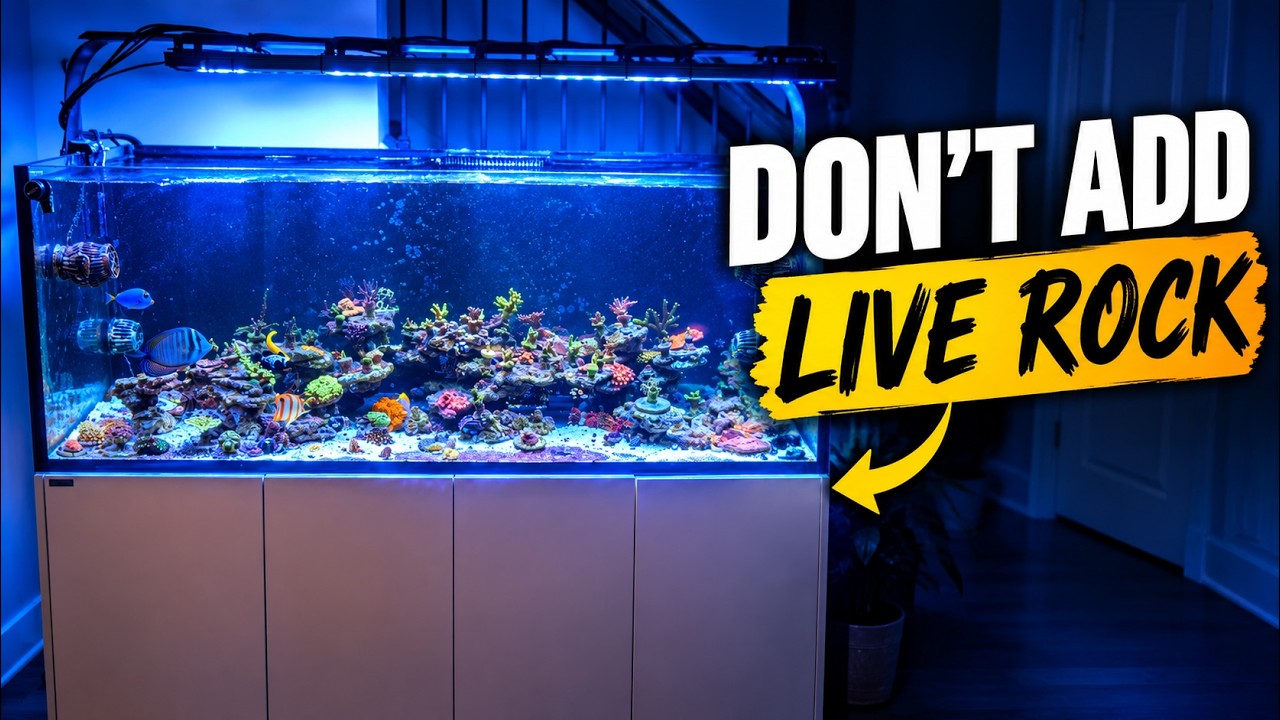
The tank behind him is an older Waterbox 220.6, roughly 220 gallons total with about 167 in the display and a 40-breeder-style sump. It was the display at his local fish store, and he talked the owner into selling it because he preferred the stand: three separate cabinets, with a dry compartment for controllers and dosing pumps, the sump, and a dedicated freshwater compartment for the auto top off.
He started it three years ago on dry sand and dry rock (Marco Rocks Colors) and went through the usual first year of dinoflagellates and cyanobacteria. About a year in, the acros finally took off. Friends came over to see how fast they were growing and how far the polyps extended.
The live rock mistake
Then Matt got an idea. He had extra live rock from another system and decided to put it in the sump to refresh the biome. The rock leached phosphate. His tank normally sits around 0.03 ppm and he doses phosphate to keep it from bottoming out. It jumped to 0.3, and the tank went into a tailspin. Dinos came back, then cyano, then turf algae, which he is still fighting four or five months later. He lost a Pearlberry acropora he loved.
The more interesting part is what happened to his dosing. He had been dosing 80 mL a day each of Triton calcium, alkalinity and magnesium. After the phosphate spike, alkalinity consumption fell to about 30 mL a day, which meant that if he had kept dosing at the old rate his alkalinity would have climbed. He avoided a crash by testing constantly and finding the new normal. Pulling the rock brought phosphate down to 0.1, and the colors are coming back now. He returned to 20-gallon water changes every two weeks, because "dilution is the solution to pollution."
His broader take is that reefers should share failures. "Even Sanjay and Mike Paletta" have hiccups, he says, and social media only shows tanks when they look great. His advice is to test alkalinity almost daily when something is wrong, nutrients weekly, and, if you skip water changes, send out an ICP test monthly or every other month. If you do water changes, a quarterly or six-month ICP is enough.
Light, flow and livestock
The tank is lit by two Gen 5 XR15 Radions on an RMS bar, bought used about three years ago, with every channel at 80 percent and overall intensity at 100. He wants the whitest light he can get, a habit from his metal halide and T5 days. The photoperiod is about ten hours with a long ramp, five or six of them at peak, and an Orphek UV light bar runs two hours a day as a supplement, since the Gen 5 Radions have no built-in UV channel. Flow comes from two MP40s on the back wall and two Jebao SOW-20 wave pumps, strong enough to splash water out of the tank. The aquascape is glued into modular pedestals and arches so it can be rearranged.
The fish list includes a Desjardini sailfin tang, a Naso tang, a copper banded butterflyfish that eats everything, a lawnmower blenny, a pair of coris wrasses, a six line wrasse, two Banggai cardinals and a royal gramma. The oldest coral is a potato chip Pavona, and the tank also holds a mummy eye chalice, Raja Rampage, Montipora, favias and a hammer. His cleanup crew includes six tuxedo urchins, an emerald crab, peppermint shrimp, turbo snails and a tiger conch. The coris wrasses have taken out most of his hermit crabs.
Simple filtration
Matt has no filter socks. He cut the baffles out of the sump because he hates washing them, and nassarius snails handle the detritus. He runs a refugium with chaeto, caulerpa and codium, harvested hard right now to keep nutrients up. As the colonies grow, he is thinking about dropping the refugium and switching to a fleece roller mat. The skimmer is a Nyos 160, a size that looks small on paper but suits a system with a refugium, and a BRS reactor currently runs only carbon. Right now he is dosing 45 mL a day of each Triton part.
Matt sees his own habit of tinkering as his biggest risk. "I am my own worst enemy," he says, because a stable tank starts to feel boring. He also enjoys the routine of testing and water changes, and would never hand his tank to a service.
Matt's goal with the community is that everybody succeeds. The Carolina Reefing Community has a private Facebook group (answer three questions to prove you're not a bot and you're in), and it also has Instagram and TikTok accounts and a website at carolinareefing.com, which links to its Zoom meetings and the events the group takes part in. "There's no dumb questions," he says.