
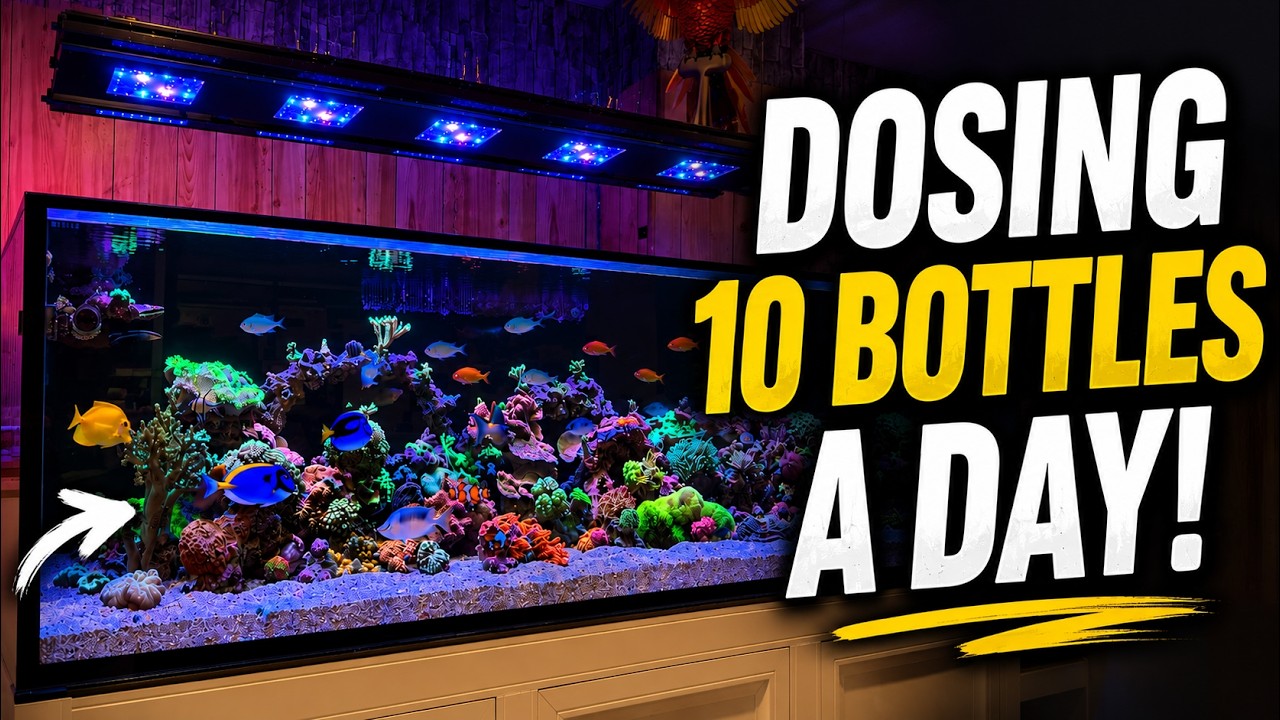
Jonathan's reef tank has moved fast. Now on his second year in the hobby, he's already gone through three tank upgrades in the first year alone. He started with an Innovative Marine EXT 200, a reef ready all in one, bought brand new. Once he started researching further, he realized he wanted a real sump so he could run gear the all in one couldn't support, so he posted in his local club, the Boston Reefer Society, offering to trade up with anyone looking to downsize. Someone had a Red Sea Reefer 525, roughly double the volume, and the two swapped. He lasted three or four months on that tank before selling it to make room for the tank he's on now, an Innovative Marine setup that just hit its one year mark.
His approach to those transfers is unconventional by his own admission. Rather than cycling each new tank from scratch, he moved livestock, rock, and water over the same day every time, using whatever water he could save from the old system and topping off the rest with new saltwater, along with new sand each time. He hasn't lost a fish doing it this way in three transfers, though he's quick to say most people would advise against it.
A lot of what he knows came from Corey, a mentor from the Boston Reefer Society who taught him plumbing, electrical work, water parameters, and how to identify and manage problems like ick, dinoflagellates, algae blooms, and bacterial issues. Jonathan says he used to panic at every parameter swing and stress Corey out with questions, until he learned that a lot of problems resolve on their own if you leave the system alone and just stay consistent with maintenance.
The dino outbreak
That lesson got tested early with a dinoflagellate outbreak he calls the worst he's dealt with, likely tied to rushing the initial cycle on dry rock without giving the tank time to build a real biological foundation. It covered the sand and started suffocating coral. He tried a UV sterilizer and adjusting nutrients, neither of which moved the needle, and eventually started carbon dosing, which he thinks helped, though he credits time and the tank settling into balance as the bigger factor. He believes it was Prorocentrum, one of the more difficult dinoflagellate strains to pin down.
These days, fish interest him more than coral. He had a rough stretch early on with coral losses that cooled his enthusiasm, and he's been in what he calls a hibernation phase with corals since, leaning instead into his fish, including a Naso tang that arrived malnourished and beat up with torn fins and has since filled out and healed.
The Moonshine Method
On dosing, Jonathan is running what's known in the hobby as the Moonshine Method: an ICP test gets plugged into a spreadsheet that calculates a precise daily dosing schedule for individual trace elements, aimed at maximizing coral color and growth while skipping water changes entirely, since the idea is that a water change would just remove what you just dosed. He's genuinely unsure if it's worth it for him. It's expensive, comparable in cost to doing regular water changes once you add up the monthly ICP tests and the roughly ten bottles of trace elements he doses by hand every day, and he doesn't keep high end coral that would need that level of precision. He's noticed his nitrates creeping up lately running the method, so he still does a water change every so often to reset, currently around 35 gallons.
Light and flow
Lighting is a Reef Breeders Meridian 63 bundle, a center panel flanked by two side bars that can each be run at different intensities. He keeps the front bar around 25 percent to suit the LPS corals he keeps up front, and the back bar around 75 percent for the SPS and acros in the rear, which he says gives him roughly 200 PAR at the sandbed and up in the 500 to 700 range at the top of the tank. For spectrum, he runs mostly full white for three quarters of the photoperiod, natural looking rather than heavy blue, before shifting into blue for the final quarter. Reef Breeders' app includes a community tab where users can browse and copy each other's lighting schedules, which is also how coral farms like Poo Tang Reefs share their exact settings so customers buying coral from them can drop in the same schedule their frags are already acclimated to.
For flow, Jonathan runs two gyre style pumps, one on each side of the tank, on a random setting cycling between 40 and 75 percent, with one running in reverse and the other forward. He also has an EcoTech Vortech MP40 on the back right wall. He's still working out the interaction between the two: his torches and Goniopora consistently point in one direction no matter how he adjusts the gyres, which he suspects comes down to the MP40 dominating the flow pattern along that side of the tank.
Keeping it hands off
In the sump, Jonathan runs a Neptune Trident to track alkalinity, calcium, and magnesium automatically. His auto top off is fully hands off: an RODI unit in the laundry room fills two 40 gallon Brute trash cans, one for fresh water and one for saltwater, and a Neptune DOS doser automatically refills the ATO reservoir from the freshwater can as needed, removing the manual top off refill he used to dread.
Find Jonathan on Instagram, Facebook, YouTube, and TikTok at @saltyjaytee.