
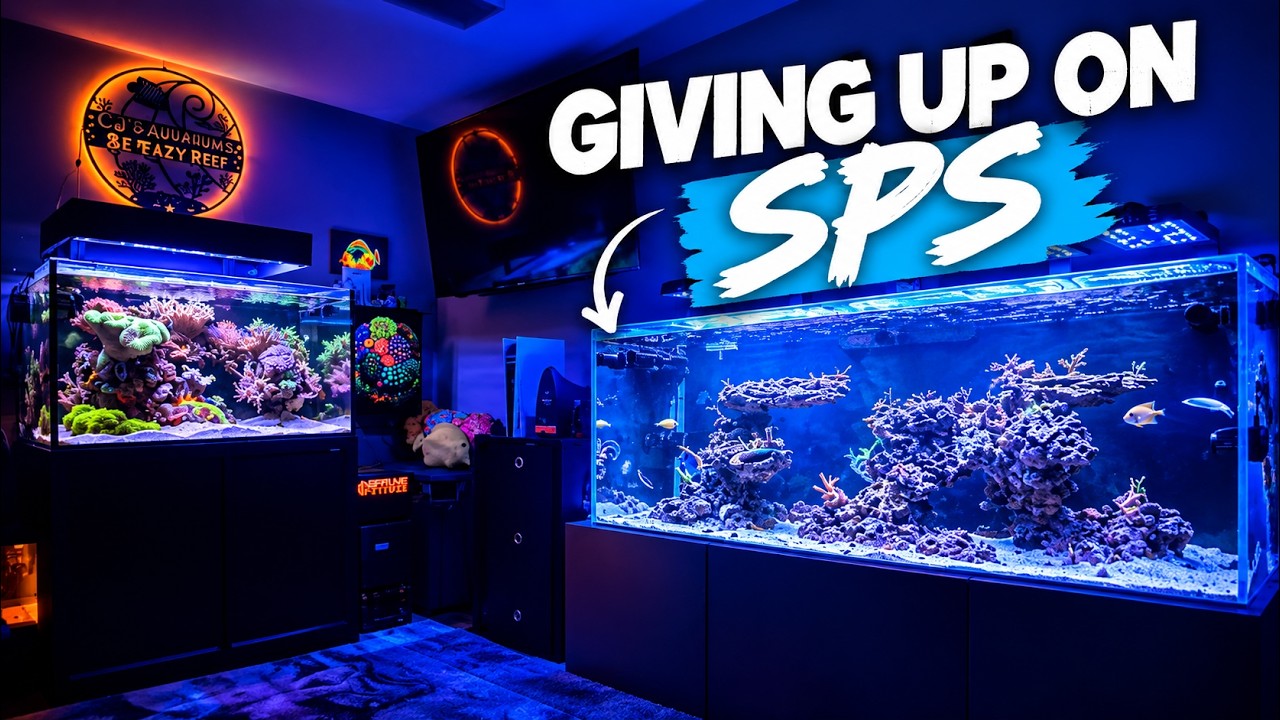
CJ started in reefing the way plenty of people do: sideways. He kept African cichlids in a 75-gallon freshwater tank and filmed it for a first YouTube channel, though he was so nervous he never said a word on camera. Saltwater pulled him in once he realized it was a whole ecosystem, from copepods all the way up to the corals and the way everything in the tank interacts. Freshwater cichlids, he says, had started to feel "too easy."
He began documenting his reef tanks mainly for himself, so he could look back at his own progress. Along the way he made videos the way he wanted to watch them: faster, tighter, and with the slow parts cut. ("I got a little ADHD or something," he says, "it doesn't keep my attention.") People noticed. Today CJ's Aquariums has more than 30,000 subscribers and close to 400 videos, and he still describes himself as "a brother with reef tanks and a cell phone."
His first saltwater tank was a drilled 37-gallon project tank, quickly replaced by a Marineland 37-gallon cube with a sump he built himself out of a 5.5-gallon Marineland tank and plastic baffles. It passed the power outage test, and it taught him to plumb. He went straight into reef, with euphyllia, hammers, torches and a few leathers. A domino damsel hosted by an anemone was his first lesson that clownfish aren't the only fish that do that.
The tank that built his channel came next, a JBJ 45-gallon all-in-one he kept for about three years. That playlist, 30-something videos covering the build, the aquascape and a long fight with Bryopsis, pulled in around half a million views. After a 120-gallon and a 65-gallon flat panel, a move and the hobby-wide price jumps that followed the import bans, he stepped away for three and a half to four years to focus on life and coaching youth football and travel ball. When he came back, it was with an Innovative Marine Nuvo EXT 75 and a plan to do something special.
The softy tank that wouldn't quit
That 75 is now close to four years old, his longest running system ever, and about 80 percent soft corals: toadstools, a long tentacle toadstool that started the size of a dime and now opens to around 10 inches, branching toadstools, finger leathers, mushrooms and GSP. It also carries an elegance coral, torches and bubble corals. The anemones started as one standard rose bubble tip and have multiplied into eight or nine, with a few rainbow splits CJ rehomed.
The tank was originally designed as a mixed reef with a lot of SPS, and CJ lit it that way. Four Aqua Illumination Blades, two Grows and two Glows in the 30-inch size, hang under a foam board canopy he built for about ten dollars. The photoperiod runs almost twelve hours and is mostly white, with blues only coming on around nine at night. He is clear that this is a mature tank doing this, not a starting point. For a new system he would shorten the photoperiod to six hours at most and cut the white.
Two myths he has stopped believing: that softies need low light and low flow. He also runs carbon and says it is close to mandatory on a leather-heavy tank, since he frags in the system and every cut sends toxins into the water.
Feeding ten times a day
The fish in both tanks are fed by auto feeder about ten times a day, each feeding only as much as they can eat in 10 to 15 seconds. The idea is simple. "How can a fish bite somebody if they're eating all day?" He mixes a blend of pellet foods, protein powders and algae and veggie feeds, then adds liquid foods by hand, and he no longer uses frozen at all.
The approach is what makes his stocking experiments possible. The softy tank holds about twelve or thirteen fish now, including a flame angel and a coral beauty that have lived together peacefully for almost three years. CJ is considering a run at four or five dwarf angels at once, borrowing the "numbers reduce aggression" logic from mbuna cichlids. His filtration is deliberately simple. A storm power surge took out his algae scrubber, so the tank now runs a fleece roller mat, a skimmer, a bag of carbon and a few pounds of Miracle Mud.
Slaying the SPS demon
The tank on his left is the reason for the title. After years of failing with SPS, CJ built a pure SPS system around the Nyos OPUS G2 440, a 100-gallon tank about three months old at the time of the interview. It started with 100 percent aquacultured live rock from Marco Rocks, and he assembled the aquascape outdoors in about an hour and a half by combining cement powder with liquid super glue, which cures in seconds, while keeping the rock wet with a spray bottle.
Everything about the setup is built for SPS. The sand is ATI white Fiji, a coarse grain that stays put in heavy flow, kept to about three-quarters of an inch after he pulled out five or six pounds. Flow comes from two overhead gyre pumps and two MP40s on the back wall, all running anti-sync at roughly 60 to 70 percent. Lighting is the new ATI Straton X, with no canopy and, in his words, zero glare, on a six-hour peak that is mostly blue.
Nutrients are the interesting part. With thirteen fish fed ten times a day, CJ is still dosing phosphate to keep it from bottoming out, and there is no algae. He credits the live rock, the converted refugium with about eight pounds of Miracle Mud, and a heavy cleanup crew. Alkalinity and the rest are handled by a Neptune Dos on the ATI Essentials two-part program, and he checks his Trident every day, watching the trend more than the number.
What's next
More than twenty frags are in with none lost so far and the polyps are fully out. CJ plans to add around thirty more acros before placing anything permanently. None are glued yet, so they sit on live rock rubble he can rearrange freely. He does not chase coral names. He cares about how the finished tank looks, and says it all starts with a good aquascape. The two agreed to revisit the SPS tank in about six months.
Find CJ on YouTube, Instagram and Facebook as CJ's Aquariums. The long-form builds are on YouTube, and daily updates are on the other two.