
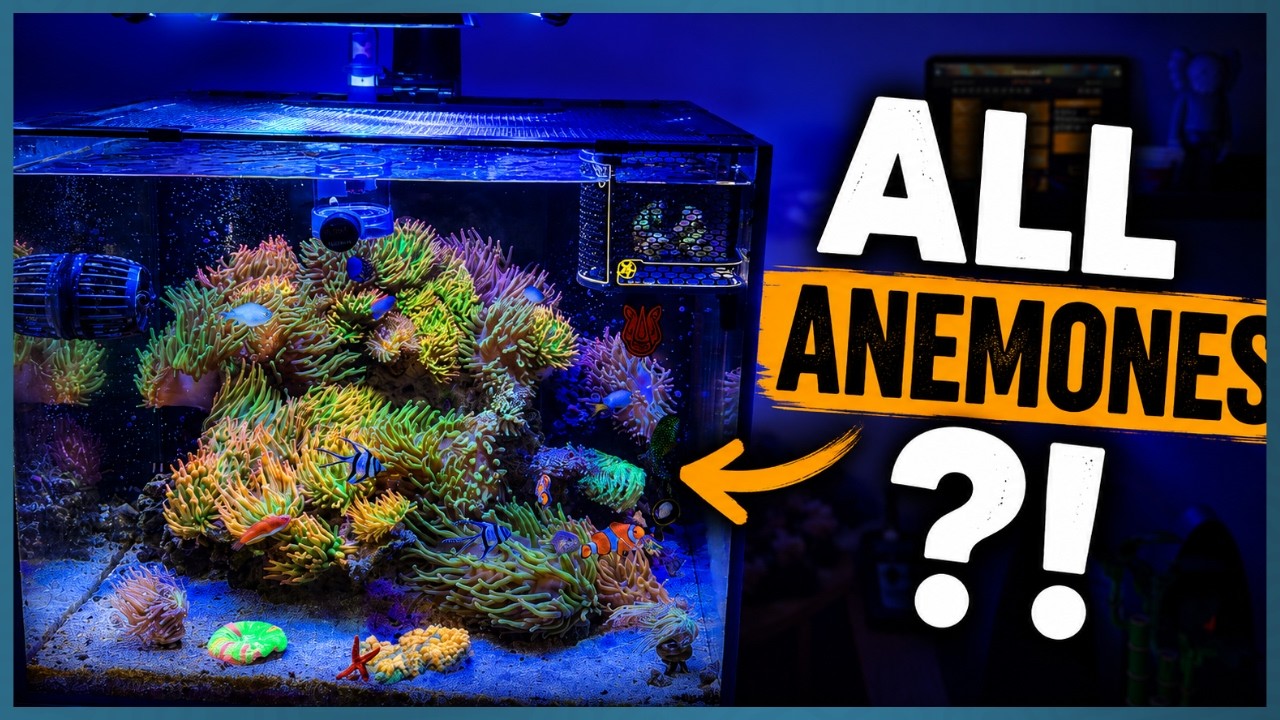
Karam has cycled through a few different kinds of tanks before landing on the one he keeps now: a mixed reef, a fish only setup, and eventually a specialty anemone tank, which he calls the easiest of the three to actually enjoy. That wasn't always the plan for this particular tank. He originally intended it as either a mixed reef or a dedicated species tank, but a move to a new house and a busier work schedule pushed him to commit fully to anemones instead, even though a handful of corals have stuck around from earlier in the tank's life. It's a Waterbox AIO 60.2, currently his only running system, about eight to nine months old and approaching its first year.
Leaving the mixed reef behind
The switch away from a mixed reef came down to sustainability more than anything else. Karam describes constant testing, chasing problems from one corner of the tank to another, and fixing one issue only to trigger a new one elsewhere, driven by how much a mixed reef depends on getting lighting, flow, and coral placement right all at once. He loved it, but found himself coming home from work and immediately falling into troubleshooting mode every day, and eventually decided the hobby needed to feel less like a source of stress.
The rockwork
The tank's centerpiece rock structure came from Chandler Rocks, a piece Karam bought at a show before he even had a tank set up for it, planning to use it eventually. When he finally started this build, he set it up entirely dry, dry rock and dry sand, with the Chandler Rocks piece as the anchor in the middle. As he began adding anemones and different color morphs, local reefers offered him extra rock from their own established tanks, which he worked into the aquascape and which he credits with speeding up bacterial diversity and coralline algae growth.
Light and flow
Lighting is a Radion G6 XR15 Pro in the center, supplemented within the last three months by two AI Blade Glow and Grow fixtures added specifically to raise PAR. The upgrade came with a tradeoff: several of his anemones shifted position in response to the change, since anemones will relocate toward or away from light and flow changes on their own timeline, sometimes not for years, sometimes within days. He runs a 9 to 10 hour photoperiod, a schedule he'd already refined on a previous nano anemone tank and carried over largely unchanged. Before adding the AI Blades, even after adding a diffuser and shades to the single Radion, he felt his anemones were surviving but not truly thriving, showing only modest coloration; the added PAR brought out noticeably more growth and color, especially in the anemone hosting his clownfish pair.
For flow, Karam runs a return pump, likely an EcoTech S2 though he's not entirely certain of the model, at 50 percent through two return lines split to each side of the tank, along with an EcoTech Vortech MP40 as his primary flow source running constantly at 15 to 20 percent rather than pulsing. Getting flow right for anemones took some trial and error: different anemones want distinctly different flow levels, from Ritteri anemones that demand strong, steady current to carpet anemones that prefer very little and tend to stay put on the sandbed, and Karam describes it as an ongoing process of nudging intensity up or down in small five percent increments roughly every month or so, more if equipment starts underperforming from buildup.
Maintenance without a skimmer
Maintenance was minimal in the tank's early months by design. Karam wanted to let the system establish itself without much intervention beyond dosing bacteria and monitoring phosphate and nitrate. Over the past three months he's shifted to a steadier routine: weekly glass cleaning and weekly water changes of about five gallons on a roughly 40 gallon display, up from an earlier biweekly schedule, without needing to disturb the sandbed at all. For anemones specifically, he watches phosphate, aiming to stay under 0.1, and nitrate, aiming to stay under 25, along with occasional pH and ammonia checks, though he considers ammonia mostly a non-issue outside of the initial cycle. He tracks alkalinity, calcium, and magnesium with one Neptune Trident and nitrate and phosphate with a second, dedicated Trident. About a month before this conversation he started dosing a two part alkalinity and calcium and magnesium supplement from Not a Feesh, a small company based near Philadelphia (notafeesh.com), after previously running the tank without any nutrient dosing at all.
There's no protein skimmer on this system. Karam tried several models and brands early on and found each one either over skimmed or barely skimmed at all, so he removed skimming from the plan entirely and leans on nutrient export through bacteria instead. His sump includes a lit chamber that intentionally grows nuisance and film algae for that same export purpose, plastic bio balls in a drip section, and three separate pumps each feeding its own reactor: two running carbon and one running bio balls, all aimed at supporting bacterial colonization rather than mechanical or chemical filtration. The light over that section runs 24 hours a day, partly for the algae and partly to help stabilize pH.
Livestock and favorites
Around the tank, Karam points to a Sunkist mushroom coral as his favorite piece, distinguished from the more common OG variety by solid orange bubbles rather than the OG's mix of colors. A clam from Clam Mania, his first ever clam, has done well enough to ease his early hesitation about keeping one; Clam Mania's clams are aquaculture raised and tracked by generation, labeled F1 or F2 depending on lineage. He's also begun experimenting with zoanthids and a few SPS frags on the side of the tank away from the main anemone display.
His fish are stocked in pairs on purpose: two Bangaii Cardinalfish, two Blue Chromis, and his breeding pair of clownfish, which lay eggs beneath one of the anemones roughly every two weeks. Rounding out the stocklist are a dottyback he isn't fully certain of the exact species, a yellow tail blue damsel he added deliberately despite the species' reputation for aggression, several wrasses including a leopard wrasse that buries into the sandbed at night, and a small starfish he can't positively identify that's been thriving in the tank for around four months.
The cabinet
The whole system runs through a custom built cabinet matched to the tank, housing an Apex controller that runs his two part dosing and one of his flow devices. A friend named Scott wired in a small blue indicator light tied to the Apex system that lights up automatically whenever the auto top off reservoir runs low, giving Karam a quick visual cue that it's time to refill.
Advice for a species specific tank
Karam's advice to anyone considering a species specific tank, anemone or otherwise, is to start small, track what you change and why, and build on that understanding one step at a time rather than trying to master everything at once.