
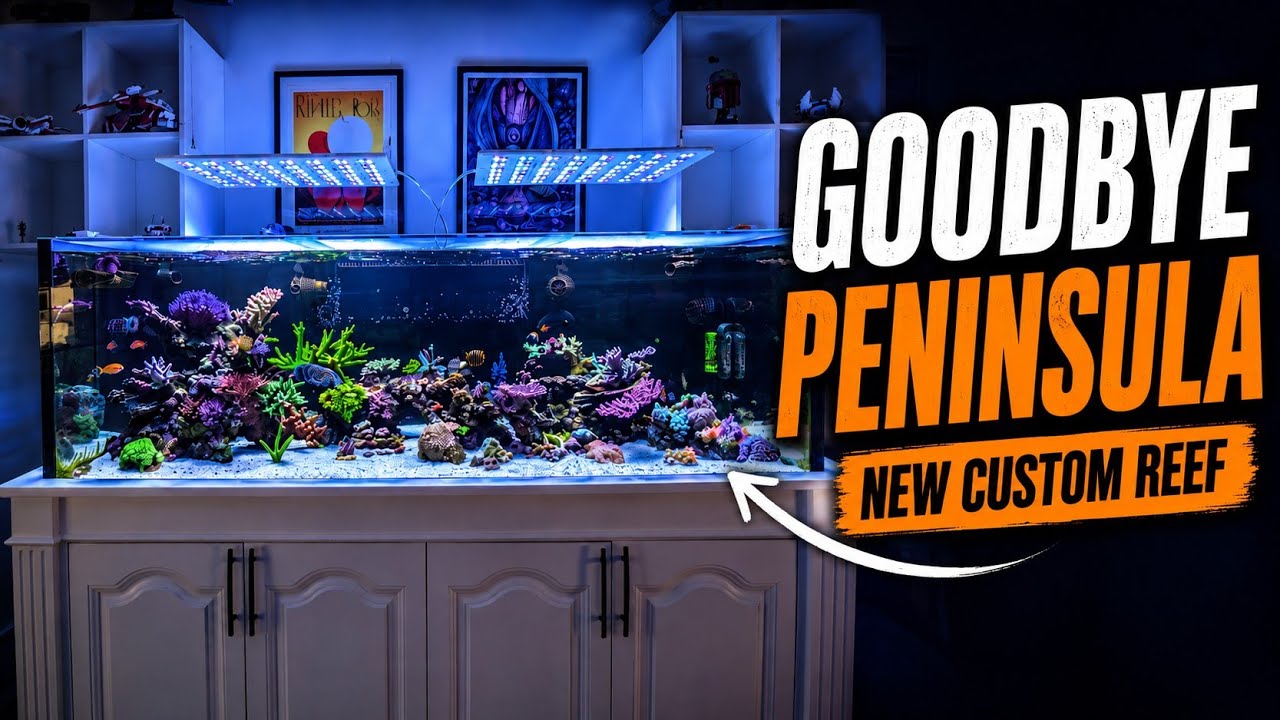
Six months after his first appearance on the podcast, JT is back with a completely different tank. His old system was a CADE 1500 Peninsula. He says he'd grown personally worried, maybe a little over paranoid in his own words, about protecting the time and investment he'd put into his animals, and that concern was enough to push him into a full rebuild rather than staying put. The result is a custom 225 gallon tank built by Derek at Ocean Life and Aquariums: 72 inches long, 30 wide, and 24 high, with a bottom braced custom stand, three quarter inch glass on the sides, an inch of glass on the bottom backed by a black ABS panel, and an external overflow that finally gets rid of the shape constraints a peninsula tank imposes.
Nearly all of the equipment carried over directly from the old system: the same lights, skimmer, UV, and controllers. The only adjustment was bumping up light intensity slightly, which JT attributes to the new tank being a foot wider and needing more coverage pushed into the corners rather than any real difference in depth.
A new flow plan
Moving from a peninsula layout to a standard rectangular footprint meant simplifying his flow plan considerably. Peninsula tanks make flow tricky because the far side has to stay clear and wiring has to run long distances to reach it. In the new tank, he's running two Panta Rhei pumps flanking the overflow, oscillating and pulsing at 80 percent on an anti-synced timer so the two never fire toward each other at once, a Maxspect Gyre XF350 along the far side closest to the house, and two Reef Octopus Octo Pulse 4 pumps, one paired with the gyre and one in the opposite back corner.
The new aquascape
The rockwork also changed direction. Rather than a series of individual structures pieced together, JT built this scape as one continuous sloping shape: a tall coral tree toward the back that steps down to a much shallower, finger like structure near the front glass, meant to evoke a reef gradually dropping off toward open water. Much of it is glued, with some pieces cantilevered in place so he can still make changes later if needed. He shaped the rockwork around where his existing coral already sat, avoiding cutting or relocating anything off the rock it was already established on wherever possible. Because the old and new tanks briefly ran side by side rather than one replacing the other outright, he had the luxury of planning the move carefully instead of draining one tank into a holding container and hoping for the best.
Sand is new: CaribSea Arag-Alive Special Grade, a coarser mix than the sand in his prior system, sitting on the same black ABS-backed bottom that helps hide the inevitable bare patches. He kept all of his old rock and reused biomedia from the previous tank to help seed the new one, and skipped bringing over any of the old sand.
Lighting and livestock
Lighting is unchanged from the prior tank: two ATI Straton G2 Pro panels, the 204 model, ATI's largest at the time, now discontinued in favor of the newer Straton X and Straton Flex lines. Each panel packs 204 individual LEDs, with no fans, cooled entirely passively through a milled aluminum body. JT runs a 12 to 14 hour photoperiod that hasn't changed much since the first episode: a whiter, more natural spectrum through the middle of the day, shifting to a heavier blue toward the end of the night for a stronger fluorescent pop on the coral. He leans toward preferring whiter light overall, both because he spends most of his time watching fish under it and because it makes blue coral, including an Oregon Tort acro he's especially fond of, stand out clearly without needing to view it through actinic glasses.
Fish carried over from the old tank make up most of the current stocklist: an Achilles tang, Bartlett's Anthias, a Lyretail Anthias, Talbot's damselfish, a Blue Throat Fairy Wrasse, a mini tang, a Scopas tang, a Gem tang, an Orchid Dottyback, two Six Line Wrasses, and two clownfish he's had since 2019. A captive bred Regal Angelfish that's been with him about a year spends its days picking at copepods and sponge growth on the rock and hasn't shown any tendency to nip coral. An Emperor Angelfish was briefly moved to the sump while JT tried it out with a vendor before returning it to the display, where it's now transitioning into adult coloration. JT notes the fish show noticeably less aggression in the new layout, with everyone finding a spot to sleep in the rockwork at night, a contrast to the peninsula tank where some fish had nowhere to hide.
One coral highlight is a purple piece, a gift from a friend, that has grown substantially larger with much richer color than when he first got it. There's also an elegance coral that started as a small frag from his local fish store and has grown from a single head to three or four.
Sump and controller
In the sump, JT runs a Bashsea sump and matching Bashsea ATO, a Red Sea Reef Mat 1200 for mechanical filtration, and a Reef Octopus Elite Internal 200 skimmer running at 80 percent that he keeps on 24 hours a day. He's moved fully onto the modern reef method of dosing and has dropped ozone from his setup entirely. A UV sterilizer with its own flow meter runs on an independent Aqua Illumination Axis 90 pump rather than off the main manifold, part of a package he originally bought from Top Shelf Aquatics, dedicated specifically to keeping his Achilles tang healthy. He also runs a Bashsea reactor filled with media similar to old style bio balls, except the media stays constantly submerged and in motion under pressurized flow rather than sitting exposed to air, which JT sees as giving bacteria more consistent access to the water passing through it compared to a standard wet-dry setup.
His controller of choice is Hydros rather than Apex, which he likes for how modular it is and how easily it lets him add or remove equipment. Push notifications and audible alerts (currently just for temperature) keep him aware of problems without having to check constantly, and he uses the Hydros modules' color changing status lights both decoratively and functionally, tying specific colors to specific modes like feeding so he can tell from across the room when a mode has finished running. At the time of the interview the lights were set to a red, white, and blue theme for the Fourth of July, though he planned to switch back to a status-focused look afterward.
What he learned
Looking back, JT says the biggest thing he learned from this rebuild was actually plumbing the system himself for the first time, after years of tanks that came pre-plumbed and pre-measured. He expects to leave this tank alone for now, sticking with the modern reef method dosing regimen he credits for the current growth, and plans to eventually build out a frag section in an open space in the sump once he adds lighting there.